Heavy-Duty Coatings Built for Industrial Demands
Industrial Floor Coating Services in Omaha for warehouses and facilities exposed to chemicals and machinery traffic
Gateway Concrete Coatings installs industrial-grade floor coating systems in warehouses, manufacturing facilities, distribution centers, and equipment storage areas throughout Omaha, Bennington, La Vista and the surrounding areas, delivering surfaces that stand up to forklift traffic, chemical spills, and the constant movement of heavy machinery. You get a floor that resists abrasion, repels liquids, and simplifies maintenance in environments where downtime and surface failure have real operational costs. Facility managers choose these coatings when bare concrete begins to crack under load, when chemical exposure creates staining and deterioration, or when dust generation from uncoated floors interferes with product quality and equipment performance.
The installation process starts with aggressive mechanical preparation that removes oils, curing agents, and surface laitance, creating the clean, open profile required for industrial-strength adhesion. Without this level of preparation, even the most durable coatings will fail under the stress of daily industrial use. The system is then applied in stages, with a primer that penetrates deep into the concrete, a body coat that builds thickness and impact resistance, and a topcoat that provides chemical resistance and a finish suited to your operational needs. In Omaha, where temperature fluctuations and seasonal moisture affect even climate-controlled facilities, a properly specified coating protects your concrete investment and reduces the need for costly repairs or resurfacing.
If your facility is experiencing floor deterioration or you want to upgrade your concrete for better performance and safety, schedule a consultation to review your space and discuss coating systems designed for industrial conditions.
What Happens When the Floor Is Built to Last
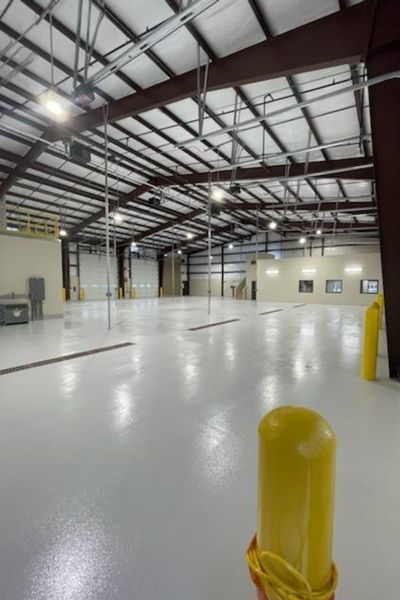
When your industrial coating is cured and ready for use, the surface no longer generates dust clouds when forklifts pass or pallets are dragged. Spills from hydraulic fluid, coolant, or cleaning chemicals sit on top of the coating instead of soaking into the concrete, giving your crew time to contain and clean them before they spread. The floor reflects overhead lighting more effectively, improving visibility in work areas and reducing the need for additional fixtures. Your maintenance team spends less time fighting stains and repairing surface damage because the coating does the work of protecting the concrete beneath.
Gateway Concrete Coatings specifies systems based on the exact conditions in your facility, accounting for load weights, chemical exposures, temperature ranges, and traffic patterns. The coating creates a monolithic surface that resists cracking, prevents moisture intrusion, and holds up through years of demanding use. You also gain a smoother surface that reduces rolling resistance for carts and equipment, improving efficiency in material handling and reducing wear on wheels and machinery.
Installation timing is coordinated with your production schedule to minimize disruption, with work often completed in phases or during planned shutdowns. Curing times vary depending on the system and environmental conditions, but most industrial coatings require at least 48 to 72 hours before full operational loads can be applied. If your concrete has structural issues such as settlement cracks or spalling, those must be addressed before coating to ensure long-term performance.
Questions Facility Managers Ask About Industrial Coatings
These questions frequently come up when facility managers in Omaha are evaluating floor coating options for their industrial spaces.
What types of chemicals will the coating resist?
Industrial coatings are formulated to resist oils, solvents, acids, alkalis, and other chemicals common in manufacturing and warehousing, but the specific resistance depends on the system selected for your exposures.
How thick does the coating need to be for forklift traffic?
Most industrial systems are applied at 10 to 20 mils thickness or more to handle point loads and abrasion from steel wheels and pallets, with exact thickness determined by your traffic volume and load weights.
Why does surface preparation cost so much in industrial settings?
Mechanical grinding or shot blasting is required to remove contaminants and create the profile needed for high-strength adhesion, and skipping or shortening this step leads to premature coating failure under industrial loads.
What happens if the coating gets damaged in one area?
Localized damage can often be repaired by abrading the affected area, reapplying coating layers, and feathering the repair into the surrounding surface without replacing the entire floor.
How does the coating improve workplace safety in Omaha facilities?
The sealed surface reduces dust and trip hazards, resists chemical penetration that can create slippery spots, and provides a uniform surface that improves visibility and reduces the risk of accidents.
Gateway Concrete Coatings works with facility managers throughout the Omaha area to assess floor conditions, specify appropriate systems, and schedule installations that align with operational needs. Contact the team to arrange a site visit and get a detailed proposal for your industrial flooring project.